The legal adult-content ecosystem includes subscription platforms, video-hosting services, live-streaming applications, discussion communities, review sites, directories, news publishers, and content-moderation vendors. These services may discuss the same industry, but they do not perform the same job. The most useful distinction is based on what a service actually does. A platform that stores videos, sells subscriptions, manages creator accounts, or hosts live broadcasts has different operational risks from a site that publishes reviews or industry information. However, the categories can overlap. A community site may also host user-uploaded media, while a review site may process affiliate payments or allow businesses to manage profiles. Legal duties therefore depend on the platform’s functions, users, location, and target markets rather than the label it gives itself. Users should examine what information a service collects, whether it hosts files, who can upload content, how payments are handled, and what reporting tools are available.
Core Function Differentiation: How Direct Distribution Platforms Differ from Community & Review Sites
Direct distribution and hosting platforms make adult content available to viewers. They may store creator uploads, stream recorded videos, provide live broadcasts, sell subscriptions, process tips, or manage private messages between users and creators. Because these platforms control or facilitate access to the content, they need systems for verifying uploaders, documenting permissions, responding to copyright complaints, reviewing reported material, securing user accounts, and handling payment disputes. Platforms that store, process, transmit, or otherwise affect the security of payment-card data may also fall within the scope of PCI DSS requirements. PCI DSS is a payment-industry security standard, not a complete adult-content compliance framework.
U.S. federal recordkeeping rules are frequently described incorrectly in this context. Under 18 U.S.C. §2257, certain producers of visual depictions of actual sexually explicit conduct must inspect identification documents, maintain required records, and make specified statements about where those records are kept. The rule does not function as a general visitor age gate, copyright policy, payment rule, or universal consent-verification system. Separate obligations may arise from laws addressing child sexual exploitation, non-consensual intimate imagery, privacy, consumer protection, copyright, and online safety. For example, U.S.-based electronic service providers must report certain apparent child sexual exploitation offenses to the National Center for Missing & Exploited Children when they become aware of them.
Information, review, and community sites usually focus on descriptions, commentary, platform comparisons, safety discussions, news, or user experiences. A review site might explain subscription policies or discuss privacy concerns without providing the underlying adult media. That distinction does not remove all platform responsibility. A discussion forum can still host user posts, images, links, and private messages. Reddit, for example, permits users who enable the relevant setting to view communities marked as mature, and it applies sitewide rules alongside community-level moderation. Its official moderation documentation describes the use of automated detection, human review, hashing, user reports, and appeals.
Community and review operators may need to address harassment, impersonation, doxxing, misleading reviews, illegal advertisements, copyright complaints, non-consensual imagery, and posts involving minors. They should also distinguish verified facts from personal allegations and clearly disclose advertising or affiliate relationships. The boundary is therefore functional rather than absolute. A service that begins hosting user videos or processing paid memberships takes on risks that do not exist when it publishes editorial articles alone.

Common Content Moderation and Operational Models in Today's Market
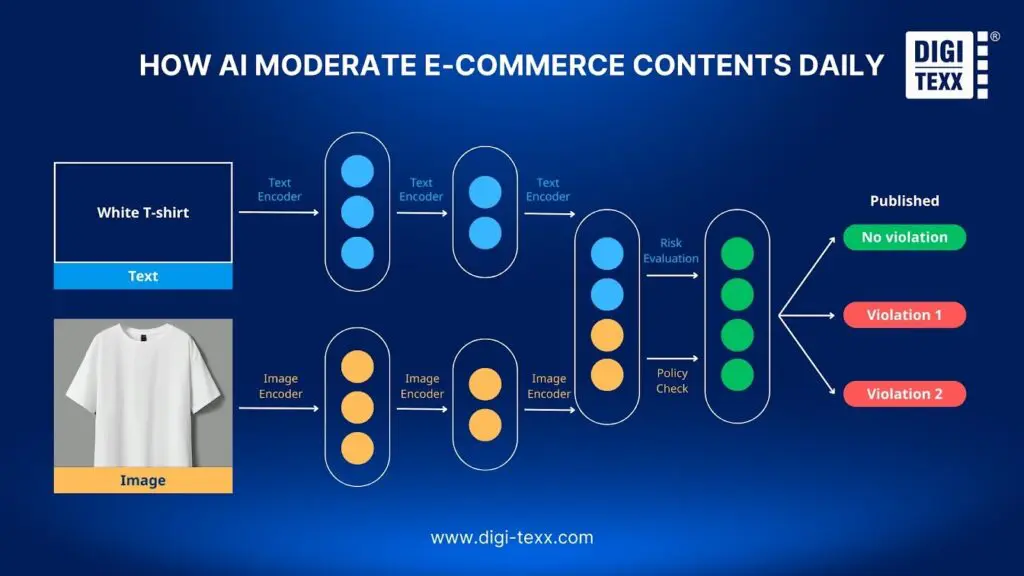
Legal platforms generally combine several moderation methods rather than relying on one filter. Automated systems can screen text, images, videos, account behavior, and upload patterns. They may detect known prohibited files through cryptographic or perceptual hashes, identify suspicious language, place potentially violating uploads into review queues, or restrict accounts showing unusual activity.
Hash matching is most useful when a harmful file is already known. A platform can compare a new upload with a stored digital fingerprint and block or review a match. It is less reliable for entirely new material, heavily altered media, or content whose legality depends on context. StopNCII provides one example involving non-consensual intimate imagery of adults. Its tool creates a hash on the user’s device and shares the hash, rather than the original image, with participating companies. Those companies can use it to help detect matching uploads on their own services. Participation is not universal, and a hash cannot remove content from every website on the internet.
Automated classification also has limits. A model may detect nudity without knowing whether an image is consensual, documentary, medical, artistic, or illegal. Text such as “leaked” or “hidden camera” may justify review, but the words alone do not prove that a violation occurred. Human reviewers remain necessary for assessing consent disputes, age concerns, context, impersonation, appeals, and cases where automated tools produce uncertain results. Reviewers need clear policies, suitable training, privacy protections, and access only to the information required for the decision.
User reporting is another important layer. A useful system should let people identify the affected content, choose an appropriate reporting reason, provide supporting information, and receive a decision. Appeals are necessary because both users and automated systems can make mistakes. In the European Union, the Digital Services Act requires covered platforms to provide mechanisms for reporting illegal content and to inform users about decisions and appeal options. These requirements apply according to the service’s role and size, not according to whether it describes itself as an adult platform or community site.
In the United States, the TAKE IT DOWN Act requires covered platforms to provide a notice process for certain non-consensual intimate depictions and remove qualifying material, together with known identical copies, within 48 hours after receiving a valid request. The law covers real, altered, and AI-generated intimate depictions. No moderation system can promise perfect detection. Platforms should measure false positives, false negatives, review time, appeal reversals, repeated uploads, and the treatment of different languages and user groups.
Modern Moderation Technologies and Age Verification Solutions Protecting User Safety
Age assurance is becoming a major requirement in several markets, but there is no single method that all legal adult services must use worldwide. Under the United Kingdom’s Online Safety Act framework, services that allow pornography must use highly effective age assurance so children are not normally able to encounter it. Ofcom identifies potentially suitable methods including photo-ID matching, facial age estimation, digital identity services, mobile-network checks, credit-card checks, open banking, and some forms of email-based age estimation. Simple self-declaration is not considered highly effective.
Age verification and age estimation are different. Verification confirms age through a credential or trusted record. Estimation predicts an age range from information such as a facial image. Neither method should be described as infallible. Digital credentials can reduce unnecessary disclosure when implemented correctly. LA Wallet, for example, allows a Louisiana resident to review a remote verification request and approve or deny the sharing process. That does not prove that every website integration stores no data; users must still review what the requesting business asks for and why.
Selective-disclosure systems can go further by allowing a person to prove an attribute such as “over 18” while withholding a full birth date or name. Yivi describes this type of privacy-by-design disclosure. However, not every digital identity provider uses zero-knowledge proofs, and the privacy properties depend on the credential, protocol, issuer, verifier, and retention policy. Facial age estimation and liveness checks may help detect simple spoofing attempts, but platforms should not claim that they block all photographs, masks, synthetic faces, or deepfakes. Biometric processing also introduces privacy, bias, security, and accessibility concerns. Services should collect only necessary data, define retention periods, protect stored templates, and provide an alternative method when a user cannot complete the biometric process.
The original claim that a RoBERTa model achieves recall of 0.98 and an F1 score of 0.86 cannot be used without a named study, dataset, label definition, and testing method. Model performance on one dataset cannot be treated as a universal moderation result. Likewise, automatic face-and-name blocking is not a standard safeguard across adult platforms. Facial recognition can create serious accuracy and privacy problems, particularly when images are edited, low quality, or contain several people.
A safer prevention workflow combines verified performer records, uploader authentication, consent documentation, hash-based re-upload detection, fast victim-reporting channels, human review, and account-level enforcement. It should also cover AI-generated impersonation and non-consensual intimate media rather than focusing only on traditionally recorded content.

Direct distribution platforms deliver, host, monetize, or manage adult content. Information, review, and community sites help users discuss services, evaluate risks, and exchange information. The categories may overlap, and legal responsibility follows the service’s actual features rather than its marketing description. Users should check whether a site hosts media, processes payments, verifies uploaders, offers effective reporting tools, explains how personal data is handled, and provides a route to challenge moderation decisions.
Platform operators should avoid treating age assurance, performer verification, consent records, payment security, copyright response, and content moderation as one compliance task. Each addresses a different risk and may be governed by different laws. The strongest safety model combines proportionate age checks, data minimization, verified creator records, automated detection, trained human review, transparent reporting, appeals, and rapid action against child sexual exploitation and non-consensual intimate imagery. Technology can support these controls, but it cannot replace clear policies, accountable decisions, and jurisdiction-specific legal review.